Warehouse space is expensive, and every wasted aisle can slow picking, replenishment, and dispatch. The right Stacking Systems help businesses use vertical space while keeping goods accessible and stable. Yet no single setup suits every warehouse. Pallet dimensions, load weight, product turnover, ceiling height, and handling equipment all affect the choice.
Industry investment is moving toward automation, but practical fit still matters. MHI’s 2024 Annual Industry Report found that 55% of surveyed supply-chain professionals expected to adopt robotics and automation within five years. That figure reflects a broad industry trend, not a guarantee that automated stacking is right for every site. A small operation with mixed cartons may benefit more from flexible shelving or stackable bins than from a costly automated installation.
Details matter. A beam that clears a pallet today may leave too little room for safe handling tomorrow. And a system designed around uniform loads can become awkward when inventory changes. This guide compares seven warehouse stacking options, from floor stacking and pallet racking to mobile and automated solutions. It considers capacity, access, space use, and operational trade-offs, using manufacturers’ specifications and recognized industry guidance where available. The rankings are a starting point, not a substitute for a site assessment. Real warehouses are messier than diagrams.
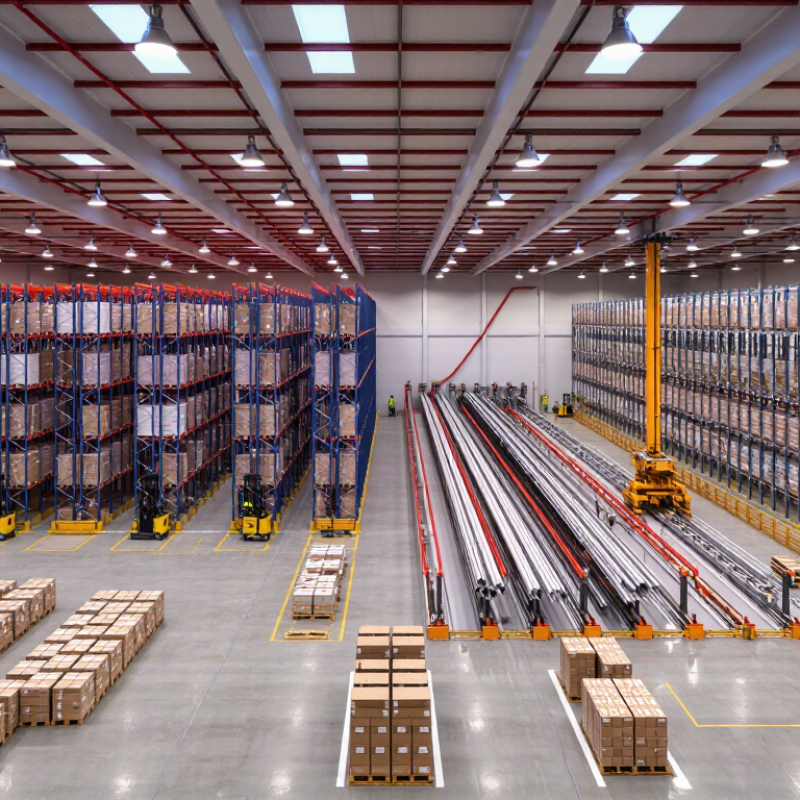
Warehouse stacking systems organize palletized goods vertically while controlling how loads are stored and retrieved. They range from floor, or block, stacking to selective racks, drive-in racks, push-back racks, pallet-flow racks, mobile racks, and automated storage and retrieval systems. Each works differently. Floor stacking places stable, compatible loads in blocks; racks support pallets at set levels and improve access. Drive-in designs save aisle space but limit access to individual pallets, while flow racks move stock forward by gravity.
The right system depends on pallet weight, product turnover, ceiling height, aisle width, and how often workers need each item. A warehouse handling many identical pallets may accept tighter storage and fewer direct-access positions. A facility with varied stock may need clearer access. The trade-off is real. MHI’s 2024 Annual Industry Report says 55% of respondents planned to increase supply-chain technology investment over the following five years. That signals interest in automation, not a requirement for every warehouse to automate.
Tips: Measure loaded pallet dimensions, including any overhang, before choosing rack bays. Check floor condition, sprinkler clearance, and forklift turning space with qualified professionals. Mark damaged uprights promptly. A tidy drawing can still miss a real-world snag: test the layout with actual pallets and equipment before committing.
| System | How It Works | Storage Density | Access and Stock Rotation | Best Suited For | Key Consideration |
|---|---|---|---|---|---|
| Block Stacking | Palletized goods are stacked directly on the floor, often in blocks or lanes, without pallet racking. | High floor-space use; stack height is limited by load stability, packaging strength, and safe handling requirements. | Usually low selectivity; access is easiest when goods are stored in shallow lanes. Often used for LIFO-style handling. | Stable, uniform loads with a small number of SKUs and relatively high quantities per SKU. | Loads at the bottom must safely support those above. Reaching goods behind front pallets may require moving other stock. |
| Selective Pallet Racking | Pallets are stored on horizontal beams in individual rack locations, with aisles between rack rows. | Moderate; aisle space is needed for forklift access. | Direct access to each pallet position; supports straightforward FIFO or LIFO picking depending on warehouse procedures. | Warehouses with many SKUs, varied inventory, and frequent access to individual pallets. | Uses more aisle space than many high-density systems; rack and floor capacity must be properly specified. |
| Double-Deep Racking | Two pallet positions are placed one behind the other on each rack face, typically accessed using a deep-reach truck. | Higher than selective racking because fewer aisles may be needed for the same storage area. | The front pallet must be moved to access the rear pallet; selectivity is lower than in single-deep selective racks. | Facilities with sufficient quantities per SKU and a need to increase pallet storage density. | Requires compatible handling equipment and inventory management that accounts for the less-accessible rear positions. |
| Drive-In / Drive-Through Racking | A forklift enters rack lanes and places pallets on support rails. Drive-in racks are accessed from one end; drive-through racks from both ends. | High, as multiple pallets can be stored deep within each lane and aisle space is reduced. | Drive-in is commonly operated LIFO. Drive-through can support FIFO when loading and retrieval are managed from opposite ends. | Large quantities of similar products, such as seasonal or batch inventory. | Pallets within a lane are less individually accessible, and forklifts operate inside the rack structure. |
| Push-Back Racking | Each new pallet pushes earlier pallets backward on nested carts or inclined rails; pallets move forward as the lane is emptied. | High compared with single-deep selective storage because several pallets can occupy each lane. | Typically LIFO: the last pallet loaded is the first one available for removal. | Multiple pallets per SKU where compact storage and faster access than deep forklift-entry lanes are useful. | Lane depth and pallet condition should be compatible with the system; it is generally less suitable when strict FIFO is required. |
| Pallet Flow Racking | Pallets are loaded at the higher end of inclined roller or wheel tracks and move by gravity toward the retrieval end. | High; storage lanes can be deep while loading and picking are separated into different aisles. | Supports FIFO: the first pallet loaded moves toward the front and is normally the first available for picking. | High-throughput goods, date-sensitive products, and operations that benefit from separate loading and picking aisles. | Pallet quality, load characteristics, lane design, and flow controls must be suitable for consistent movement. |
| Mobile Pallet Racking | Rack rows are mounted on powered or manually operated mobile bases. Rows move to create an access aisle where needed. | High for pallet storage because several permanent aisles can be replaced by one or a small number of movable aisles. | Direct access is available to a selected rack aisle after the mobile rows open; only a limited number of aisles are open at once. | Space-constrained warehouses storing many palletized products with moderate access frequency. | Requires suitable floor conditions, safety controls, and allowance for aisle-opening time and traffic management. |
They store palletized goods vertically and help workers retrieve loads. Options include floor stacking, racks, and automated systems.
Consider pallet weight, product turnover, ceiling height, aisle width, and access needs. Measure loaded pallets, including overhang.
It suits stable, compatible loads with many similar pallets. Mixed goods can become hard to reach. That gets awkward.
Workers can access each pallet directly, which helps with varied stock and frequent picking. The wider aisles use space.
Pallets sit several positions deep, reducing aisle needs. Reaching a rear load may mean moving the front pallet first.
Push-back racks roll pallets backward on inclined rails. Pallet-flow racks move them forward by gravity, supporting first-in, first-out rotation.
Check floor condition, sprinkler clearance, ceiling height, and forklift turning space with qualified professionals. Test the layout with real pallets.
Dense layouts may slow retrieval or block access. Compare usable pallet positions with aisle width and picking routes. Drawings miss things.
Warehouse Stacking Systems are methods and structures used to organize goods vertically, make better use of floor space, and support efficient storage and retrieval. The right solution depends on the size, weight, and variety of stored items, available building height, handling equipment, inventory turnover, and how quickly workers need access to individual loads. Common options include selective pallet racks, drive-in and drive-through racks, push-back racks, pallet-flow racks, cantilever racks, and stacking frames, each suited to different storage patterns and operational needs.
These seven systems vary in storage density, selectivity, accessibility, and installation requirements. High-density designs can increase capacity but may limit direct access to specific loads, while more selective systems make retrieval easier but use space differently. Before choosing a system, assess inventory flow, aisle layout, floor and rack load limits, and equipment compatibility. Clear operating procedures, routine inspections, safe stacking practices, and adequate training help ensure the chosen system supports both efficient warehouse operations and a safe workplace.

 Yuanzhang Rack